Goodbye Godzilla: The Last-Ever Nissan GT-R Has Left The Building
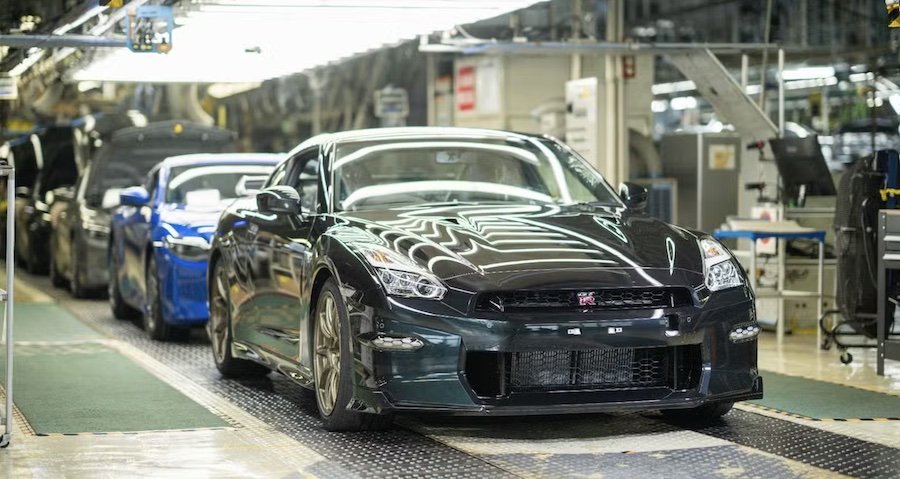
The final example was a Premium edition T-Spec wearing Midnight Purple paint. Rather than putting it in a museum, the car went to a customer in Japan. Workers at the Tochigi plant where the GT-R was assembled gathered to celebrate the sports car's retirement.
Don't be sad about the GT-R's finale. Nissan says it's committed to building a new GT-R, but it's not entirely clear when that will be. The company stated it doesn't have a "precise plan" about when the next-gen model arrives. Nissan promises to reserve the moniker for a truly special product.
“After 18 remarkable years, the R35 GT-R has left an enduring mark on automotive history. Its legacy is a testament to the passion of our team and the loyalty of our customers around the globe. Thank you for being part of this extraordinary journey. To the many fans of the GT-R worldwide, I want to tell you this isn’t a goodbye to the GT-R forever, it’s our goal for the GT-R nameplate to one day make a return.”
- Ivan Espinosa, Nissan president and CEO
Nissan previewed what became the GT-R with a concept that debuted at the 2001 Tokyo Motor Show. It took until 2007 for the production-spec R35 to arrive. At the time, the GT-R was a world-class sports coupe. The 3.8-liter twin-turbocharged V6 initially made 473 horsepower, and the six-speed gearbox sent power to a cutting-edge all-wheel-drive system. It was also a relative bargain at a base price of around $77,000, while offering the performance of vehicles that cost significantly more.
Nissan continually improved the GT-R during the model's life. It received multiple engine upgrades that eventually pushed the output to 592 hp. There was also the GT-R50 with styling by Italdesign that made an impressive 710 hp and had a limited production run of just 50 units. For the 2015 model year, the Nismo grade arrived as a track-focused version of the coupe. It had an upgraded suspension, including re-tuned shocks and spring rates. There were also improved brakes, revised steering, and 20-inch wheels.
An intriguing fact about the GT-R was that over the 18-year production run, just nine people were responsible for hand-assembling every engine. Each powerplant required around 6,000 hours to put together.
The R35 GT-R was also a track star. It found success in Japan's Super GT series and scored a win at the 2015 12 Hours of Bathurst. In 2008, the GT-R was one of the fastest cars at the time around the Nürburgring Nordschleife, with a time of 7 minutes and 29 seconds. For comparison, a Chevrolet Corvette C6 ZR1 lapped the course in 7:26.4 the same year. Meanwhile, a GT-R Nismo went around the 'Ring in 7:08.679 seconds in November 2013.
There have been rumors and speculation about the GT-R's future for years. With nearly two decades on the market, the car inevitably became stale in the eyes of many enthusiasts. Despite the multiple upgrades, it was in a segment that thrived on the introduction of new products that were better than what was already on the market.
While Nissan has been clear about a new GT-R coming, there are few official details about it. There's the possibility the car could adopt a hybrid powertrain, but there were also rumors of it being a full EV. The Hyper Force concept was a high-performance EV that looked a little like a GT-R and had electric motors pumping out a total of 1,341 horsepower.
Nouvelles connexes


