JLR Sues BYD Over Claims It Stripped Down a Defender to Clone It
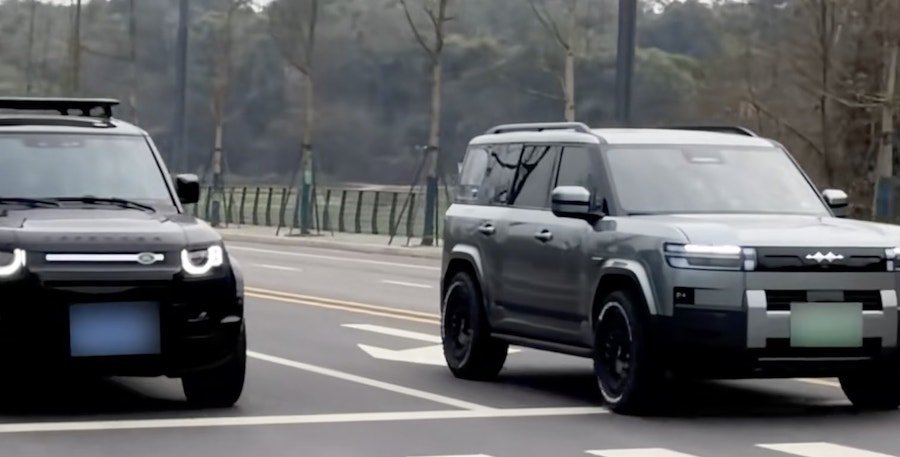
The BYD Ti7 and the Land Rover Defender share a striking visual resemblance in overall silhouette, proportion, and rugged design, but the English claim that it is also engineering that the Chienese stole from their model. They both come with an upright three-box design with a nearly completely flat roofline, terminating abruptly into an ultra-sharp, vertical rear end.
Viewed from behind, the resemblance confirms that the Ti7 is a Land Rover Defender wannabe. The Chinese clone got a side-hinged rear tailgate, which supports a massive external spare wheel carrier, a design and functionality choice that models such as the Mercedes-Benz G-Class and Land Rover Defender have pioneered.
Both SUVs sport robust C-pillars, flared, prominent square wheel arches, and blacked-out contrast roofs. However, there is one significant element that sets them worlds apart, and that is the front fascia. While the Defender comes with the unmistakable, semi-circular LED headlights set into the clean grille, the BYD Ti7 has a much busier front end.
The Chinese model features split C-shaped matrix LED headlights and a massive horizontal light bar, connecting the front grille elements. Furthermore, the Defender rolls off the production line with its signature structural metallic mesh vent on the front fenders. The Ti7 trades this for simpler, aerodynamic horizontal lines, stamped into the side panel doors.
While the window line along the side of the BYD Ti7 angles slightly upward toward the rear pillar, giving it a slightly more modern, urban look, the Defender maintains a strictly flat horizontal window edge from hood all the way to tailgate. This is what Top Gear labeled as a "Chinese Defender clone," and they obviously make a point.
JLR's legal team is aiming not only at the copycat styling, but also at technology and engineering cloning. The allegations rely on the suspicion that BYD acquired and completely stripped down a production Land Rover Defender to reverse-engineer its technology and structural engineering for use in the Ti7.
JLR argues that BYD deliberately crossed the line from being inspired by the Defender to actually executing an illegal breach of intellectual property rights. Back in August, court-appointed bailiffs unexpectedly swept through two of BYD Europe’s main corporate offices in the Netherlands.
Acting on JLR’s behalf, officials seized a massive collection of digital records and internal documents from the offices in Schiedam and Hoofddorp. According to reporting from The Guardian, JLR asked for this surprise raid to be fast-tracked so that the suspicious files would be secured before they could potentially be altered or deleted.
The legal showdown is taking place in The Hague, Netherlands. JLR reportedly chose the Dutch legal system because the Netherlands has highly robust intellectual property laws that are exceptionally favorable toward handling claims of multinational IP theft.
BYD’s defense team slammed JLR’s tactics, fiercely labeling the entire file seizure an overreaching, legally invalid “fishing expedition” that took far too many unrelated files. The two auto giants have already faced off in a preliminary courtroom hearing last month. A preliminary ruling is scheduled for this coming Wednesday, November 11.
The judge will decide which parts of the confiscated digital data the British company is legally permitted to use as evidence and whether JLR has established a strong enough baseline for the copycat case to formally proceed to trial.
The British house has been there before. Back in 2019, Jaguar Land Rover won a historic three-year legal battle in Beijing court against Jiangling Motors Corporation. The court ruled that the Landwind X7 was a direct, illegal clone of the Range Rover Evoque and ordered the Chinese company to pull it from showrooms.
A year later, the company lost a massive battle in London when it tried to trademark the structural shape of the original Defender to block billionaire Jim Ratcliffe from building the Ineos Grenadier. The High Court ruled the classic boxy shape was not legally unique enough to warrant exclusive protection, which is exactly why JLR’s new case against BYD leans heavily on reverse engineering rather than just exterior design.
In the meantime, the BYD Ti7 is ready to steal a big portion of the Land Rover Defender's market share as it undercuts it by nearly 20,000 pounds ($26,740) in its home market, the UK. While the Land Rover Defender 110 PHEV, officially marketed as the P400e, kicks off at 68,465 pounds ($91,866), the BYD Ti7 PHEV is a 47,995-pound ($64,175) deal.
Despite the price gap, the two have very similar specs and performance figures. The British model comes with a six-seat layout, while the Chinese SUV can carry up to seven people. The Defender PHEV drives through the factory gate with a 2.0-liter turbocharged inline-four engine and an electric motor. Together, they produce a combined 399 horsepower (404 metric horsepower) and 472 pound-feet (640 Newton meters) of torque.
That is enough to make the plug-in hybrid SUV accelerate from 0 to 60 mph (0 to 97 kph) in 5.4 seconds and top out at 119 mph (191 kph). The BYD Ti7 is 0.9 seconds quicker (4.5 seconds) and maxes out at 118 mph (190 kph).
The Chinese SUV is powered by a 1.5-liter turbocharged inline-four, operating alongside two electric motors in an all-wheel-drive setup for a total of 402 horsepower (408 metric horsepower) and 623 pound-feet (845 Newton meters) of torque.
The BYD Ti7 is equipped with a larger 35.6-kWh battery pack, which stores enough energy for a drive of up to 75 miles (120 kilometers) under the WLTP testing cycle or 102.5 miles (165 kilometers) under the domestic Chinese CLTC cycle.
In the meantime, the Land Rover Defender P400e sports the 19.2-kWh (15.4 kWh usable) battery pack, which is good enough to make the off-roader drive as far as 27 miles (43 kilometers) on electric power only under the WLTP cycle.
Nouvelles connexes


