Mini's Latest Special-Edition Trim Is An Ode To Its Rally Legacy
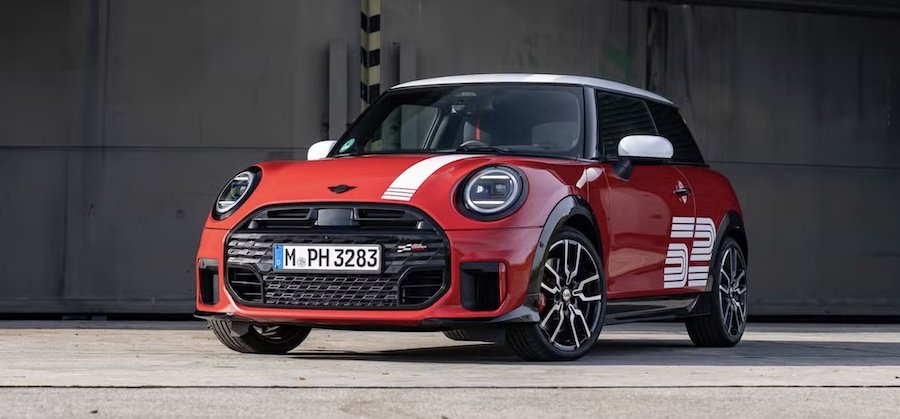
Available in only limited numbers, the Victory Edition package is offered on MINI’s John Cooper Works hatchback, its John Cooper Works Electric alter-ego, and the standard Cooper S in Europe.
The 1965 Victory Edition will also be available to US customers, albeit exclusively on the two-door JCW Cooper, from next month onward. Prices start from $46,220, plus destination and handling fees. That's approximately $7,300 more than a standard two-door JCW Cooper, just FYI.
1965 Livery Edition Colors, But No Power Upgrades, Sadly
Replicating the two-tone livery used by the Monte Carlo-contesting Cooper S in 1965, the Victory Edition features new Chili Red exterior paintwork and a contrast Glazed White roof. White racing stripes feature across the hood, the roof, and the rear hatch, and ‘1965’ graphics have been stenciled across the C-pillar and on the rear hatch. Look closely, and you’ll see the Chili Red paint has also been used to detail the floating center caps on those 18-inch JCW Lap Spoke 2-tone wheels.
Inside, this tributary theme continues. Red stitching contrasts the black sports seats and dashboard upholstery, while red and white detailing adorns the six o’clock spoke on the Mini’s sports steering wheel. The ‘1965’ graphic also appears on both door sills. In a nod to the original Cooper S’ race number, a ‘52’ stencil features on the back of the Mini’s keyfob, across both exterior door panels, and even each wheel's valve cap.
Sadly, the 1965 Victory Edition is primarily a cosmetic upgrade, though that does mean US fans will still get the JCW’s souped-up 2.0-liter TwinPower Turbo four-cylinder. Said four-pot produces a robust 228 horsepower and 280 pound feet of torque, which is sent to the front wheels via a seven-speed dual clutch automatic gearbox. Interestingly though, those cosmetic upgrades have dropped the JCW’s zero to 60 mph sprint from 5.9 seconds to 6.1 seconds.
Mini Makes Its Mark On The Monte
It would be a few years before the first victories rolled in, but Mini was already causing a stir at the biggest endurance rally on the planet as early as 1962. Finland’s Rauno Aaltonen, at the wheel of Alec Issigonis’ brilliantly designed hot hatch, was sensationally leading that year’s event with less than two miles to go. The tiny four-cylinder, equipped by John Cooper with a plethora of upgrades, had proved a giant-killer.
But a misjudgment by Aaltonen, and the resultant rollover, meant defeat was cruelly snatched from the jaws of fairytale victory. The chastened Finn returned in 1963 to finish 3rd overall, securing Mini’s first class win in the process. But it would ultimately be Northern Ireland’s Paddy Hopkirk, alongside co-driver Henry Liddon and aboard the far feistier Cooper S, that finally secured Mini’s first landmark win in 1964. Finland’s Timo Mäkinen and Britain’s Paul Easter repeated this success the following year in a grueling event that saw only 35 of the 237 entrants go the distance.
Amidst this success, it’s often forgotten that Mini, which won the event again overall in 1967, initially locked out the 1966 podium as well, with Timo Mäkinen once again on top. Farcically, however, all three Minis, and seven further entries, were later disqualified, French officials having nebulously decided that the Mini’s four additional headlamps did not meet regulations. 5th-placed Pauli Toivonen, who just so happened to be driving a French-built Citroën S1, was elevated to victory, though the Finn apparently refused to accept the garlands.
Nouvelles connexes


