Netherlands King Takes a Closer Look at the Prestigious Dutch Flying Car
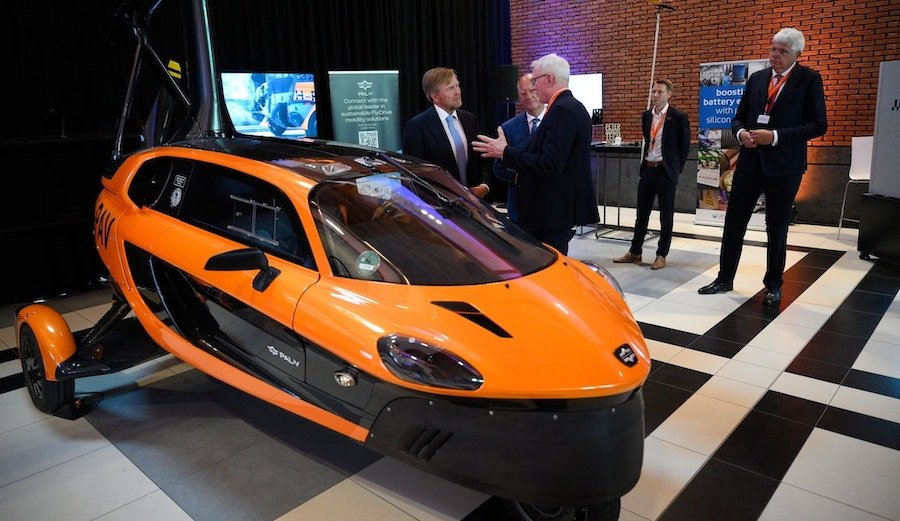
Anyone who’s into actual flying cars must be familiar with the PAL-V name, one of the few in this niche sector to have made it this far and show a promising future in terms of full certification and commercialization. Most recently, the Dutch king himself, His Majesty Willem-Alexander, got close and personal with the famous 100% Dutch flying car, and this was one of the highlights of the FME 75th anniversary celebrated at the Lowman Museum in The Hague.
Sadly, PAL-V didn’t win the award it was nominated for, the Peter Wennink Tech Award, which rewards technological innovations with a clear social and economic impact, but the sheer fact that it was one of the three major nominees is a win by itself. The nomination came as a confirmation of not only Pal-V’s feasibility and reliability, but also of its potentially huge positive role for the future of personal mobility.
LejdenJar (who won the award) and AQUABATERRY are both experts in battery technology with a strong focus on sustainability, which further emphasizes that clean technologies are prioritized across industries. In aviation, AAM (Advanced Air Mobility) is one of the most powerful directions, and what makes concepts like the PAL-V is that they are at the crossroads between AAM and road mobility, with a double positive impact on both.
PAL-V’s flying car isn’t a gimmick, even though, at first glance, it looks like a peculiar contraption. Essentially a FlyDrive vehicle, the Liberty integrates gyroplane technology into a conventional car. This allows it to be driven like a regular car on the road, and also fly like an aircraft, with its gyroplane blades acting as wings.
From a regulatory perspective, the Liberty flying car must be double-certified to operate safely both on roads and in the air. On the road, Liberty promises a non-stop range of more than 800 miles (1,315 km), and twice as more with a single fuel stop. In the air, it would fly at 11,000 feet (3,350 meters), and reach approximately 100 mph (160 kph).
At the FME (the employers’ organization for the technology industries in the Netherlands) 75th anniversary event, the Dutch king himself was interested in finding out more about the Liberty flying car and experiencing what it feels like to be inside such a futuristic vehicle. He didn’t take it for a test drive, but this first close encounter has surely sparked His Majesty’s interest in exploring the Liberty further and maybe, one day, owning one.
Liberty wasn’t only considered the world’s first true flying car, but it’s also one of the few that have made considerable progress toward commercialization. Earlier this year, PAL-V has secured the Initial Assessment from the RDW (the Netherlands’ Vehicle Authority), which officially recognizes it as an automotive manufacturer, and its wins aren’t limited to Europe – the company’s big plans include a FlyDrive Experience Center in the Middle East.

Nouvelles connexes


