Someone Is Finally Making A Diesel PHEV Pickup Truck
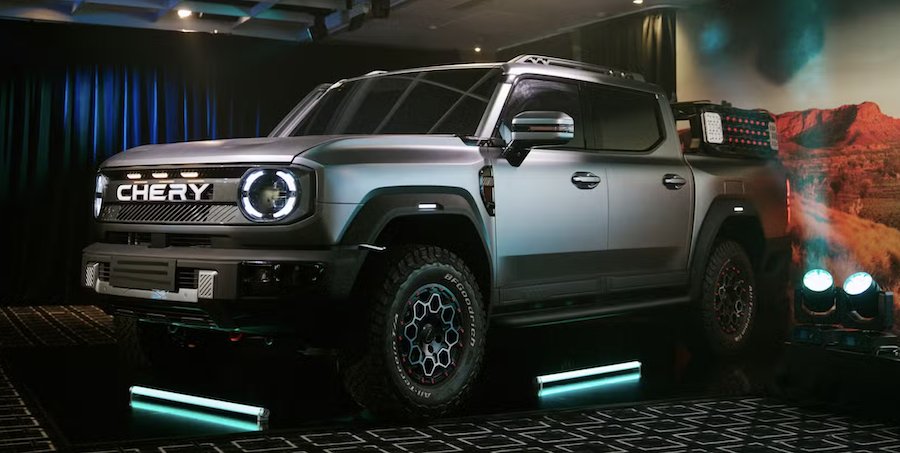
Mercedes-Benz is one of the few automakers to combine the two, and soon, Chinese automaker Chery will join them. The company revealed a concept version of its upcoming pickup called the KP31, and it will have a diesel hybrid that's also a plug-in. It sounds quite intriguing.
A Boxy Beast Out To Do Battle With The Ranger
While Chery says that this KP31 is a concept, it seems like it's a concept in the Honda sense. By that, we mean that this basically is the production model with only some minor exterior changes to make it a concept. That's fine with us, because it's a handsome pickup truck with endearing round daytime running lights that soften the otherwise blocky body. The grille with American-style clearance lights does feel lifted straight from Ford's Raptors, and the fender lights look a bit GMC, but it's unlikely you would confuse it for either. The giant word mark on the grille helps.
Among some of the features that probably won't appear on every trim are the bed rack, traction boards, snorkel, and possibly the extra rugged bumpers. Most versions will probably have more tame rolling stock, too. This example sits on 17-inch wheels with 285/75 tires, which are just shy of 33 inches in diameter.
On the topic of size, the KP31 shown here is 220.9 in. long, 75.6 in. wide, and 75.8 in. tall. Chery says the production model will be 6.3 inches shorter than the concept. We suspect Chery is talking about a completely different cab and bed configuration being available. Regardless of the final dimensions, they're all pretty close to other midsize pickups it will compete with in Australia, such as the aforementioned Ford Ranger and Toyota Hilux.
As for the nitty-gritty details, Chery only released the basics, and not all of them. Of course, the headline feature is the plug-in diesel powertrain. It features a 2.5-liter turbocharged four-cylinder, though it didn't give any specifications on power, battery capacity, or efficiency. Chery also confirmed that a gas-powered plug-in will be available, too. As for towing and payload, the diesel hybrid KP31 will be able to handle a 7,716-pound trailer and up to 2,205 pounds of cargo in the bed (though not at the same time). That matches the gas-powered Ford Ranger plug-in hybrid for towing, and exceeds it for payload.
Why Diesel Hybrids Are Unusual, And Why A Supercar Builder Thinks They're Brilliant
On paper, hybridizing diesels makes a lot of sense. Diesels are naturally more efficient than gasoline engines, and that has been the case since their inception. Hybrid powertrains are also extremely efficient. So, it would seem obvious to take one of the most efficient internal combustion engines, and use efficiency-improving hybrid technology to create a super-efficient engine.
It's also fairly easy to create diesel from sources other than oil pulled out of the ground. For all of these reasons, Christian von Koenigsegg, the founder and head of the eponymous supercar company, thinks diesel hybrids are great. He particularly likes the idea of plug-in versions like this Chery, which could operate electrically around town, while extending range for long trips.
There are reasons, though, that it isn't as easy as it looks. One of the issues is that diesels are more temperature sensitive than gas engines. They're cleaner and happier when they're at normal operating temperature. With a hybrid, the engine has to start and shut off repeatedly, and frequently isn't at a particularly high operating temperature.
Diesels are also heavy. This is because they have to be strong enough to handle the compression necessary to ignite fuel and air purely from pressure. That adds weight, and weight can cost efficiency. It can also increase cost in general, whether that's with the engine itself or just having to beef up various other supporting structures. Of course, in the case of a truck like the Chery, weight becomes less of a dynamic issue, and some truck markets will accept extra cost, such as in America.
We also live in a post-VW Dieselgate world. It's a world where VW isn't even the only company to have a diesel emissions scandal. These scandals highlight two problems. The first, of course, is image, as diesel is no longer viewed as particularly environmentally friendly. The other is that there are legitimate issues with managing emissions from diesel engines, issues that are more easily managed with cleaner-burning gasoline.
Nouvelles connexes


