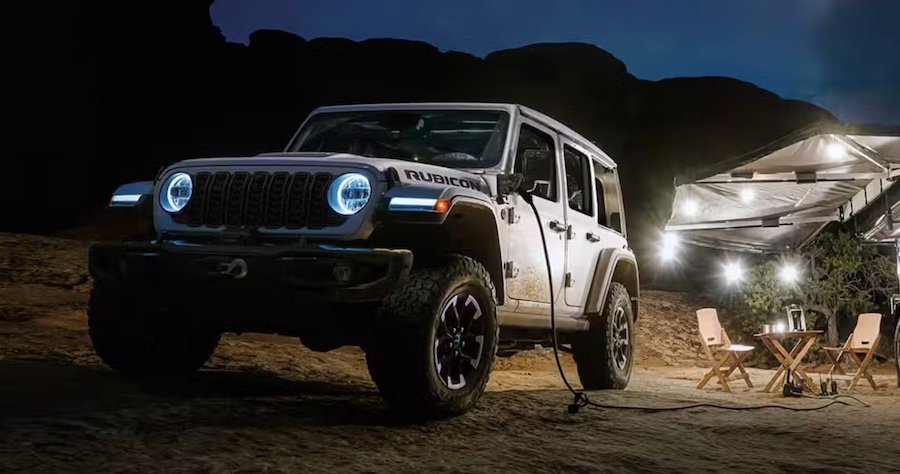
Very little of that future has materialized, as Stellantis is canceling electrified projects and pivoting hard back to Hemi V8s. But it appears that Stellantis has made progress on at least one of the future technologies featured in that video: drone integration.
Stellantis Patented An In-Vehicle Drone Docking Station
The Stellantis patent we uncovered details a built-in docking station for a drone in a vehicle. The drone would launch from and return to the vehicle. It would recharge inside the vehicle while docked. The vehicle’s ECU would manage that entire process. However, vehicle occupants would be able to take manual control of the drone through a graphical interface or through an app on a smartphone. Passengers would also be able to set their own flight paths and altitudes.
Essentially, the drone would dock in a storage compartment. The patent drawing shows the bin between the seats. It would then launch out of a hole in the roof, potentially a moonroof. The vehicle would monitor weather conditions with sensors and local weather data to ensure safe launch conditions or to recall the drone as needed.
That's a very good question, but hardcore off-roaders might already have an answer. It won’t aid in any vital driving functions; use cases will be limited to low-speed applications. A commercial drone can’t keep up with a passenger vehicle, much less perform functional tasks while doing so. The patent suggests using aerial photography or video, surveillance and scouting, inspecting remote areas, and delivering or retrieving small items as potential applications.
From a Stellantis perspective, off-roading could be an ideal use for it. Deployed from a Jeep Wrangler or Gladiator, it could be an extra set of external eyes to help guide the driver down a tricky path. That is, provided the area isn't covered with trees.
Stellantis Is Not The Only Manufacturer To Explore Drones, At Least In Concept Form
Other manufacturers have included drones with concept vehicles. Polestar’s O2 concept, which gave birth to the Polestar 6 roadster, featured a drone when it debuted. However, Polestar did not really come up with any practical use for one besides shooting a super-cool video of yourself driving the roadster.
"Deployable while in motion, the drone films the driver, allowing them to star in their own films about what it's like to be behind the wheel of Polestar O2. And these movies don't have to be action either (though one of them is). Set one of the other of three flight film modes, the drone flies in swooping arcs, as opposed to sharp dives, creating a smoother, more atmospheric feel. The third mode films the occupants close-up during roof-down driving," Polestar said in a statement.
"The flying objects are Audi Light Pathfinders, which generate their lift in the same way as bladeless fans produce their air flow," the company said in a statement. "Thanks to their markedly lightweight design, they can fly ahead of the AI:TRAIL, consuming comparably little energy in the process, and illuminate the path ahead, thereby replacing headlights entirely. If desired, the on-board cameras generate a video image that can be transmitted to the display in front of the driver via Wi-Fi, turning the Pathfinders into eyes in the sky.
When the AI:TRAIL is stationary, the drones can also illuminate the surrounding area from their position on the roof; for example, when the occupants are enjoying a picnic next to the vehicle. They can also illuminate the interior through the transparent panoramic roof if the occupants prefer to remain inside the vehicle."

Nouvelles connexes


