The Honda Fit Turns 25: Why This Tiny Hatchback Changed Small Cars Forever
Key Points
- The Honda Fit redefined subcompact hatchbacks, offering space, versatility, and broad market appeal.
- CEO Hiroyuki Yoshino championed its development as Honda's bold effort to revitalize the segment.
- The Fit was a global sales success, also overthrowing the Toyota Corolla in its first full year in Japan.
Redefining the Subcompact Hatchback
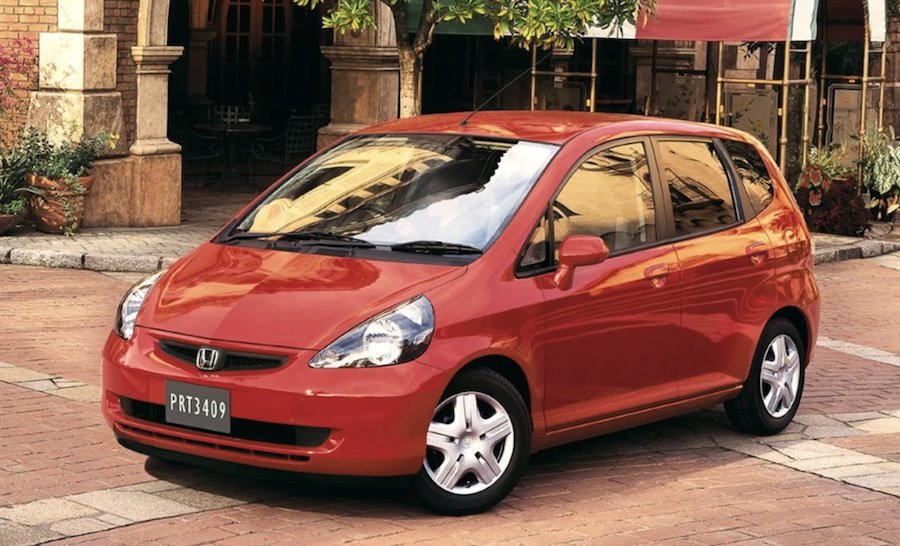
One could say that the original Honda Fit did wonders to change the image of subcompact hatchbacks around the world. Before its introduction in 2001, cars of this type were cramped, compromised, and really felt like penalty boxes. One only bought it because that’s what the budget allowed, but for some reason, the first-generation Fit’s appeal went beyond penny pinchers.
It was a smash hit in Japan, massively popular in Europe, and a surprise success in America. The first Fit was that rare breed of car that’s loved by many, almost impossible to hate, and a true world car by any measure. As it turns 25 this year, it’s a good time to take a look back original Fit.
Before the Fit
Believe it or not, Honda was actually struggling in the subcompact hatchback class for years. We’re talking about cars smaller than the Civic, and the Fit’s predecessors weren’t exactly raking in sales in its home market or anywhere else. To trace the roots of the Fit, one must go back to the ’80s with the first-generation Honda City.
The City was built to complement the Civic, which had begun to grow in size by that decade. It slotted somewhere in between Honda’s kei car offerings and the Civic, and was successful in its home market. The City was also among Honda’s first turbocharged models, and who can forget the Motocompo scooter that was offered as an option? It was also sold in Europe as the Jazz for just three short years, so we reckon its reception there wasn’t as warm as in Japan.
For its second generation, the City continued its role as being the junior Civic Hatchback, although it wasn’t as revered as its predecessor. It was discontinued in 1994 and eventually replaced by the frankly anonymous-looking, largely forgettable Logo in 1996. By then, Honda was losing ground in the small(er) hatch class in Europe and Japan, and a radical rethink was needed.
Enter, Hiroyuki Yoshino
The name Hiroyuki Yoshino isn’t a name often mentioned outside of Japan, but he was a crucial figure in the Fit’s story. Appointed as Honda’s CEO in 1998, right at the cusp of the Asian Economic Crisis and in the middle of the post-Japanese Economic Bubble burst. Yoshino had become worried about the brand’s standing in the subcompact market. In the company’s own words, “Yoshino had a serious concern that failing to demonstrate its true strength in this category would eventually damage the image of the Honda brand, which will put Honda in a difficult situation.”
To address that, the CEO took it upon himself to help develop the Fit, which isn’t something that can be said of many automotive CEOs. He entrusted Takeo Fukui, the president of Honda R&D at the time, to lead operations on the spot, with Yoshino keeping a watchful eye. He was in close contact with the development team, giving them free rein with daring ideas, and was willing to ‘take responsibility for whatever resulted.’ The Fit was actually a huge gamble for Honda and its last-ditch effort to prove it still had skin in the subcompact hatchback game.
Moment of Truth
The Honda Fit was launched in Japan on June 21, 2001, with sales commencing the following day. It rode on a totally new architecture called the Global Small Platform, which employed a centrally mounted gas tank that allowed for a raised driving position, more cabin space, and cargo space previously unseen in subcompact hatchbacks.
It also featured a twin-spark 1.3-liter engine dubbed i-DSi to maximize economy and performance from such a tiny displacement. Honda also wanted to give it higher levels of refinement, hence the full double-door seals for improved sound insulation. Product planners then went ham on maximizing the cabin by adding clever storage throughout the interior, and those revolutionary ULTR seats not only folded flat but also flipped up their seat bottoms for even more usable space for tall items.
Honda had invested heaps of time, money, and effort towards the creation of the Fit, but it all paid off. In its first full year of sale in Japan, it did the unthinkable. It outsold the Toyota Corolla, the country’s best-selling car for 33 years straight. That’s like knocking off the Ford F-Series from its perch, so it was a massive deal in the Fit’s home country at the time.
Going Global
With Japan conquered, it was time to take on Europe. For decades, Honda didn’t have a hatchback to entice VW Polo, Ford Fiesta, and Peugeot 206 shoppers to its showrooms. It tried with the anonymous-looking Logo in 1999, but ultimately failed to capture the market. In England, it was sold for just nine months in 2000. Honda Europe needed the Fit, and they finally got it in 2002.
For legal reasons, it couldn’t be called the Fit as Opel owned the rights to the name, so Honda simply dusted off the Jazz nameplate and applied it to the car. It was an instant hit in the Old Continent, offering something entirely different in its class. After that, it was introduced in Australia (late 2002) and Southeast Asia (2003 to 2004), also carrying the Jazz name. Thailand was chosen as the production hub for the ASEAN region, but other Honda plants began building it, namely Indonesia (due to overwhelming demand), Brazil, and even China.
Five Years Later
The Fit had been a massive success in most parts of the world, but one region it hadn’t been to was North America. That said, it seemed an unlikely product for the U.S and Canada, and the Civic Hatchback had long been the smallest Honda available in those two countries. But for reasons we’d love to know, American Honda didn’t go for the Euro-market Civic Hatch, instead choosing the Fit to serve as its hatchback for the U.S. and Canada.
It was launched in America in April 2006, about five years after the Japanese premiere. The federalized Fits came with a 1.5-liter engine producing 117 hp and, unlike the global model, had a five-speed automatic instead of a CVT. A five-speed manual was also available. To comply, it had noticeably different bumpers, longer than those sold everywhere else.
Short but Sweet
Turns out, it was the right move to bring the Fit over the Euro Civic Hatch. The car received critical acclaim, and the market responded by lining up to buy it. American Honda couldn’t stock them fast enough, so there was actually a bit of opportunity cost with impatient buyers heading to Toyota, Scion (remember them?), and Nissan dealers instead. Still, it managed 27,934 sales in 2006 alone — not bad for a Civic Hatchback stop-gap.
Sales kept rising until the end of its short life in America, when it was replaced by the second-generation model in March 2008 for the 2009 model year. The first-generation Fit was already towards the end of its life cycle by the time it reached the U.S, but it still managed to shine despite that.
It was enough to pave the way for the second-generation Fit to see even greater success than its predecessor. By the third generation, however, the crossover craze had truly gripped America, and the Civic Hatchback had been reintroduced. By 2020, Honda had discontinued it, and the fourth generation didn’t make it stateside. Nonetheless, Honda proved that a subcompact hatchback can be more than just basic point A to B transport and offer more than its size suggests.
Nouvelles connexes


