The Tinytanic Is the World's Smallest Houseboat, Cute and Perfectly Functional
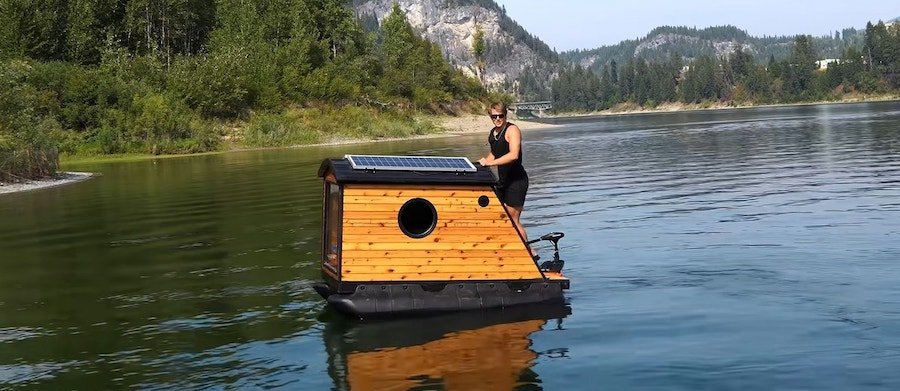
Because size isn't always an indicator of might or skill or competence, Tinytanic is, despite its diminutive size, a perfectly functional watercraft that recently completed its maiden journey. It was a short trek but a successful mission: 12 miles (19 km) of floating down Pend Oreille River in Washington, traveling from Metaline Falls to the 233-foot (71-meter) Peeweee Fall.
During this maiden journey, which also doubled as the first buoyancy test as a completed project, Tinytanic proved it was as sound as a boat as it was as a house, which was the idea from the start, since its creator had promised the world's smallest houseboat.
That creator is DIY YouTuber David Rule, famous for his various attempts at creating some of the world's smallest mobile homes, both on land and on water. He doesn't do these projects for the actual records, though, as you probably guessed, but they do help with getting more attention and clicks to the resulting videos.
David is always up for a dare and a fun project, and Tinytanic proved a little bit of both. The inspiration for it was another houseboat that claimed to be the smallest in the world, Zach Fowlers' rowboat hull that offered about 35 square feet (3.2 square meters) of living space onboard. As with other projects, David tried to make his smaller, while retaining basic functionality.
The Tinytanic came out at 8 feet in length and 3.5 feet in width (2.4 by 1 foot), offering a living footprint of just 28 square feet (2.6 square meters). It's not an official record because David probably did not apply for certification, but it's definitely smaller than the watercraft it was inspired by.
Unlike Fowlers, though, he opted for a pontoon float instead, as he explains in the video at the bottom of the page. Tiny pontoon floats would serve as the base on which he added a cedar platform, on top of which he set out to build the "house part of the houseboat."
The Tinytanic had to be lightweight in addition to being small, so David used only cedar, pine, and plywood for the construction, with a lick of liquid rubber and a sheet of aluminum for the roofing. Polycarbonate windows, two round ones on each side and an extra-large one on the front of the home for visibility and plenty of natural light, were added after the frame and sidewalls went up.
For a project whose main priority was lightness and compactness, Tinytanic came out surprisingly good-looking inside and out. David combined the two types of wood to add a bit of personality to the build, all the while keeping an eye on structural integrity and durability.
The interior had to be both bedroom and kitchen, with a dedicated storage compartment for the electronics like a 100Ah marine lithium battery and a charge controller. To keep the space from feeling too cramped and to allow ventilation, David opted for a rear wall from zippered tent awning that he could open whenever he wanted to.
He also added a 12V fan and a small vent to circulate the air inside the tiny cabin. A battery monitor, a USB plug, and an on and off switch for the fan represented the command panel, located by the entry.
Because of the small footprint David worked with, he couldn't make the cabin higher than 42 inches (106 cm), so interior headroom was just enough to sit up. The length of the space was divided into two sections, one of which would hold the bed and the other a three-segment continuous counter that would have to do as a kitchen.
As such, the latter came with a sink with a 12V pump that drew water from the lake and filtered it, before it went into a wastewater "tank" under the sink that was actually an empty juice container. A single-burner butane cooktop, of the removable kind, and a small 12V fridge completed the appliances here.
David admits that it's no chef's kitchen, but it's just the kind of setup that would work for the basics for the planned three-day trip. Speaking of which, it would be carried out with help from an all-electric 30-lb thrust Minn Kota trolling motor, which David mounted on custom rear wooden brackets.
The two 100W solar panels on the roof powered the motor and everything else inside the cabin, with the exception of the cooktop. David did run into some issues on the second day, when he had to use the motor sparingly because he was running out of battery juice. He also remarked that Tinytanic was exceptionally slow, but also surprisingly stable.
In the end, a build like this one isn't about speed or performance or, for that matter, outstanding comfort. This is still a mobile home in the sense that it has the basic features of a home designed for living in on the road, but it's not meant to be very comfortable or even that good-looking.
The biggest achievement of a mobile home like Tinytanic is that it exists. So thanks to David for taking us all on this adventure with him.


Nouvelles connexes


