Toyota's Latest Hydrogen Engine Idea Borrows Tech From Gas Cars
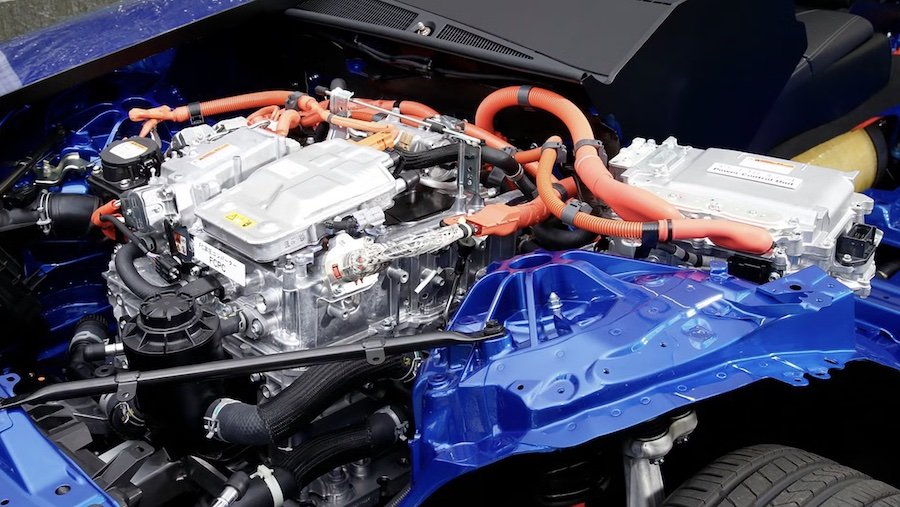
To prove the technology, the company even took the system racing in Japan. There were some initial teething issues when one of them caught fire during testing at the Fuji International Speedway. Since then, the company announced plans to take the tech to the 24 Hours of Le Mans in 2028. It can even power a sauna.
Now, Toyota is patenting an improvement of its hydrogen-combustion engine. The tech reduces the amount of oil that can reach the combustion chamber, creating a better-running version of the powerplant. Let's take a deeper look at how the automaker is achieving this.
United States Patent and Trademark Office
The illustration for this patent (above) shows most of the elements that you'd find in a gasoline-fueled combustion engine. There's a cylinder with a crankshaft and connecting rod allowing a piston to reciprocate up and down inside of it. At the top end, there are intake and exhaust valves that open and close as the powerplant strokes to complete the combustion process. To see what Toyota is doing, focus on section R2 on the left. The piece labeled 45 is a PCV valve that attaches the intake manifold (28) to the unidirectional valve (60) leading to the crankcase (15).
The major change to this Toyota patent is an air passage connecting the intake passage and the crankcase. A unidirectional valve with a check valve is on a housing on the outer wall of the crankcase prevents the backflow of air. According to the automaker's description, when hydrogen combusts, the process creates water. The situation means "the amount of moisture contained in the blow-by gas of a hydrogen engine tends to be larger than that of a gasoline engine." Therefore, the crankcase ventilation system is especially important when burning H2.
In addition, the blow-by gas in the intake can contain oil and water. At low temperatures, these substances can condense and liquify, forming an emulsion. If the weather is especially cold, the water could even freeze. The solution in this patent places the valve's housing near the crankcase, so that it heats up quickly, limiting the amount of emulsion or freezing that can occur.
Toyota explains that without the unidirectional valve the air would go directly to the oil pan, leading to increased aeration, and atomized oil possibly reaching the combustion chamber. When burnt, there would be greater oil consumption and worse emissions.
The general basis of this idea isn't new. Many combustion engines use PCV valves for achieving crankcase ventilation. Since there's more moisture in a hydrogen system, this version is more robust.
Toyota's patent also outlines several alternate versions of this idea. For example, the unidirectional valve doesn't require its own, separate housing. Instead, the piece could integrate into the crankcase's wall. It's also possible to locate these pieces on different places of the crankcase, depending on the necessary packaging.
Toyota's Hydrogen Development
Toyota is putting a lot of effort behind developing the hydrogen-combustion engine. In addition to this patent and the racing efforts, the company is also working on carbon-capture technology for the powerplant. There was also an idea for an electronically controlled water-injection system that would cool the cylinder preventing abnormal combustion.
There's still the lingering problem of a lack of hydrogen-refueling infrastructure around the world. However, Toyota's H2 combustion concept would keep the internal combustion engine running in the future. With a lower barrier to entry than the full swap to fuel cells, the automaker's idea could be a way forward for hydrogen-powered automobiles.
Nouvelles connexes


