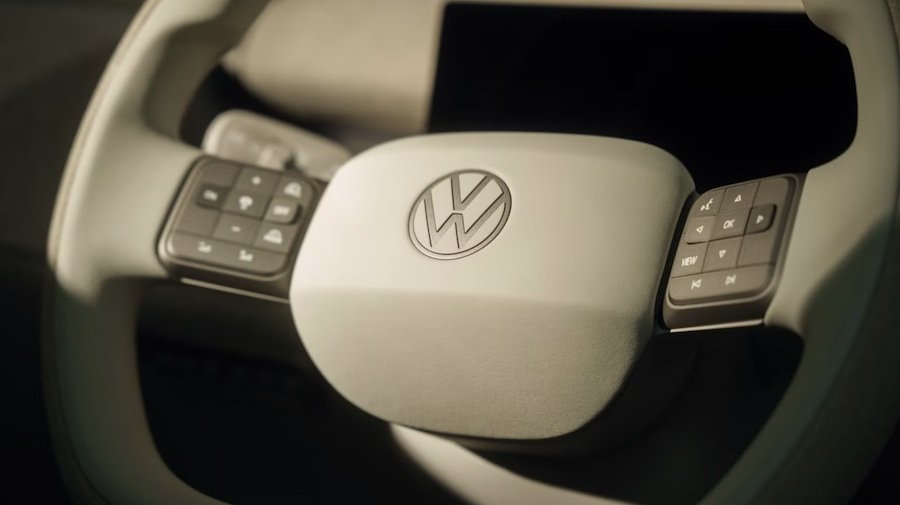
Although the company has been quickly backpedaling from its touch-sensitive controls in favor of physical buttons (like those in the 2025 Tiguan), the patent nevertheless describes a somewhat complicated-sounding system that will feature a driver-facing camera that can detect the user's viewing direction and suggest controls appropriately.
Control Multiple Functions With Just A Glance
The Volkswagen patent describes myriad potential applications for eye tracking, ranging from less important tasks like operating the entertainment system or adjusting heated seats to more crucial functions like windshield wipers, headlights, and exterior mirror adjustments. Theoretically, such a system would make physical controls redundant, which would benefit the automaker by reducing manufacturing complexity (and therefore cost) across its entire lineup. After all, it's easier to add functions via software updates than to install actual hardware.
A camera facing the occupants can target their gaze, detecting where they're looking. The patent says that the car could then display appropriate controls on a simplified set of universal hard buttons on the steering wheel or dashboard. For example, if the driver looks toward the air vents, the buttons might display temperature or fan controls. Volkswagen also says in the filing that the system could instead project a hologram control panel, which the user could pinch – such a function would be familiar to anyone who has used Apple Vision Pro or Meta Quest augmented-reality goggles.
A Solution That's Looking For A Problem?
Volkswagen's latest infotainment system, as found in the Tiguan, is actually pretty good. It uses a smattering of physical buttons, including a volume knob that doubles as a drive mode toggle, as well as nicely organized menu structures to make adjusting the car's functions pretty simple. As a result, it's hard not to view VW's eye-tracking patent with some skepticism, since the company's "better idea" touch sliders and haptic steering wheel buttons have frustrated consumers for the last four years.
The automaker could perhaps ease into eye-tracking tech with gesture controls, which BMW and Mercedes-Benz use to decent effect. The principle is simpler, with a camera detecting finger movements in an area a few inches in front of the infotainment screen. In BMWs, making small circles with your pointer finger turns the volume up or down, for example. The system doesn't always work, and even when it does, it's not any easier than just turning a physical volume knob.
Nouvelles connexes


