How Honda Built a V-Twin Engine to Beat Ducati
Key Points
- Ducati dominated WSBK in the 1990s with powerful V-twin engines against four-cylinder rivals.
- Honda responded by developing the RC51 V-twin, claiming major racing titles and rivaling Ducati.
- The RC51's short-lived success established its legendary status, now celebrated by collectors globally.
Italian Dominance
It’s 1999, and Ducati has won eight out of the last 12 Superbike World Championship (WSBK) riders’ titles. Over the preceding decade, their unique V-twin-powered machines proved to be a dominant force in a field otherwise populated by V-fours and inline fours. Honda, on the other hand, with their reputation for engineering excellence and legendary motorsport heritage, struggled to match the Italians. The Honda RC45 race bike, powered by a 750-cc V-four motor, was an excellent machine in its own right, but struggled to compete with the larger-capacity Ducati V-twins. Larger capacity because the WSBK regulations of the era capped displacement at 750cc for four-cylinder motors, while twins were allowed up to 1,000cc.
Twins vs Fours
At the time, Ducati was known for its lightweight, short-stroke V-twin engines while Japanese motorcycle brands had spent years perfecting their high-revving four-cylinder motors. The smaller and lighter pistons in these four-pot motors, combined with the more frequent power pulses, allowed for higher rpm and consequently higher peak power than a twin-cylinder engine of similar capacity. The regulations were designed to even out this peak power deficit and level the playing field, but didn’t take into account the V-twin’s inherent character — strong, instantly-accessible torque through the midrange. The kind of torque that aggressively accelerates you out of a corner and towards the next one, without having to wait for the motor to spin up into the stratosphere. On most racetracks, peak power doesn’t mean much without the ability to efficiently put that power down, and Ducati’s dominance demonstrated just that.
If You Can’t Beat Em…
While Ducati celebrated its 1999 championship victory, Honda was already preparing for some big changes. Acknowledging that it would be impossible for their 750s to match the Italian machines, which had grown in size from 851cc in 1990 to 996cc in 1999, Honda Racing Corporation’s (HRC) top bosses made the decision sometime in the mid ‘90s to take a page out of Ducati’s book and develop a big-bore V-twin of their own. While this would give Honda engineers the freedom to go beyond the 750cc cap, successfully building a competitive engine with a whole new philosophy on the first attempt would be a formidable task. They would also be going toe-to-toe with a manufacturer with a lot more experience, as Ducati had been refining the art of building high-performance V-twins since the ‘70s.
Uncharted Territory
Honda had spent the last two decades perfecting its V-four engines; the decision to abandon this configuration and start a whole new development journey from scratch could not have been an easy one. The goal? Direct the might of Honda’s R&D, vast technical knowledge, and engineering expertise towards creating a competent superbike with a V-twin heart to take on the Ducati 996 in the 2000 WSBK season. Essentially, the team behind the project was tasked with building a better Ducati than Ducati themselves!
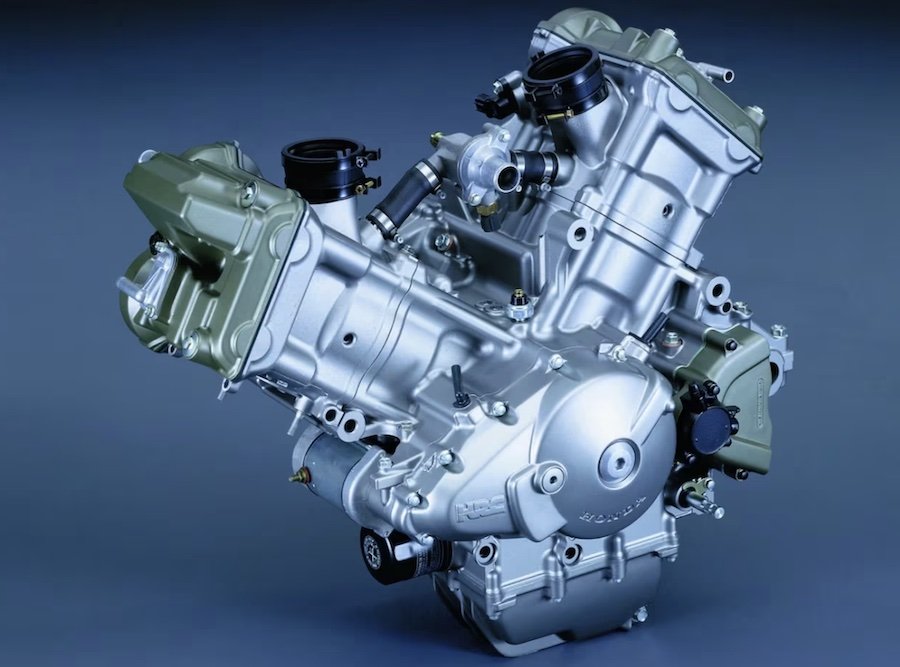
What they finally came up with was a 999cc V-twin with a 90-degree angle between cylinder banks, four valves per cylinder, a 100mm bore, and a 63.6mm stroke. The dual overhead camshafts were driven by a series of gears for Swiss-clockwork-like precision, the perfectly-balanced forged steel crankshaft was designed to handle sustained high-rpm operation, short-skirted cast-aluminium pistons and aluminum composite cylinder sleeves were given friction-reducing coatings, and forged steel connecting rods featured a unique ‘nutless’ bolt-through-rod design to reduce weight and improve durability.
The Honda RC51
In early 1999, Honda’s American factory rider Colin Edwards was spotted testing a pre-production, V-twin-powered superbike at Australia’s historic Philip Island circuit. This was the motorcycle would be revealed to the public a year later, officially designated the RC51 and marketed in the U.S. as the RVT1000R. In other markets, including Europe, Japan, and Australia, it was sold as the VTR1000SP1. It was also what Edwards would ride in the 2000 WSBK season.
Going Racing
The RC51 proved to be a resounding success in its inaugural year, outperforming the Ducatis and bringing Honda and Colin Edwards the 2000 WSBK constructors’ and riders’ championship titles. Ducati hit back the following year and snatched the title back, but Honda’s engineers were already busy refining the RC51 with various minor alterations, including larger throttle bodies, smoother fuelling for more predictable throttle response, better injectors, a different swingarm, and changes to chassis geometry to fine-tune the bike’s handling. Back to the races with this new SP2 version of the RC51 in 2002, Honda proved once and for all that they had built the superior V-twin superbike by reclaiming the rider’s championship, with the RC51 earning the ‘Ducati Killer’ nickname in the process.
Unfortunately, the RC51’s reign did not last very long; 2003 saw a reworking of the WSBK rules that finally allowed 1,000-cc four-cylinder motorcycles to compete. Honda had by then done what they had set out to do — prove that they have the engineering chops to adapt, innovate, and outdo the competition at their own game. Prioritising the development of Valentino Rossi’s RC211V MotoGP prototype race bike, the company opted out of the championship that year. They did, however, return in 2004 with the all-new CBR1000RR Fireblade, but that is a story for another day.
Aside from these two WSBK titles, the RC51 had many more racing successes. These included a victory at the 2000 Isle of Man TT, the top spot at the 2000 24 Hours of Le Mans endurance race, top spot in the 2002 AMA championship, victories at the Daytona 200 in 2002 and 2003, and four consecutive victories at the Suzuka 8 Hours endurance race from 2000 onwards, culminating in a podium lockout in 2003. During its short time in the sun, the RC51 was raced by legends including Joey Dunlop, Valentino Rossi, Colin Edwards, Nicky Hayden, Daijiro Kato, and many more.
RC51 Legacy
Although Honda officially stepped away from racing the RC51 after 2003, the road-going version of the bike remained on sale till 2006, when it was finally replaced by the CBR1000RR as the brand’s litre-class flagship and halo product. Today, the RC51 has achieved legendary status, is highly sought after by collectors and enthusiasts alike, and has left an indelible mark on motorcycle racing history.
Related News


