MV Agusta Brings Back an Engine Design Missing for Decades
Key Points
- The square engine layout uses dual crankshafts for compactness and increased torsional rigidity.
- MV Agusta unveiled a five-cylinder "quadrato" concept engine, potentially exceeding 240 horsepower.
- Modern cooling and luxury focus may overcome previous cooling and cost disadvantages.
A square or U engine layout is an extremely rare engine architecture that generally features four cylinders arranged in a square block with two parallel crankshafts — one for each pair of cylinders — geared together and rotating in opposite directions. The main advantages of such a layout are its compact size and the fact that shorter crankshafts offer more torsional rigidity and are less prone to twisting under load.
Very few manufacturers have even attempted developing such an engine for series production, the only one of note being British motorcycle brand Ariel, who produced square four engines in various capacities from 1931 to 1959. Japanese manufacturers Yamaha, Suzuki, and Kawasaki also experimented with this layout in the 1980s, primarily for their two-stroke grand prix race bikes, but the design soon faded into obscurity.
Fast Forward to 2025
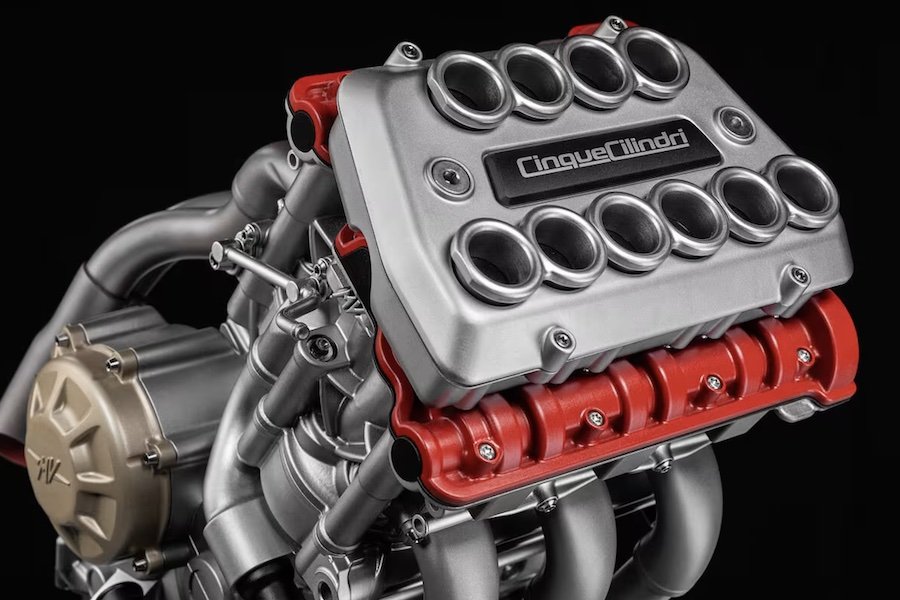
Italian motorcycle manufacturer MV Agusta, known for building some of the most exotic machines on the planet, has now revived the dual-crank U engine architecture, almost a century after Ariel first brought it mainstream. The high-end boutique brand, whose exclusive creations are often considered rolling pieces of art, revealed their creation to the world at EICMA 2025, this year’s Milan Motorcycle Show. The engine in question in a five-cylinder take on the square layout with three pistons driving the forward crank and two pistons driving the rear, so its more trapezoid than square — something that has never been attempted before.
What We Know So Far
At the moment, this engine exists only as a concept, but MV Agusta has shared a few details, as well as their future plans for it. The company states that its five-cylinder quadrato (Italian for square) engine platform will be offered in varying displacements ranging from 850 cc to 1150 cc, and will power models across various segments, from supersport motorcycles to naked street bikes, and even tourers. MV Agusta also claims that the platform will be capable of generating over 240 horsepower and 96 lb-ft of torque, and rev to over 16,000 rpm — all while weighing under 132 lbs.
The square engine architecture offers several inherent advantages over more common high-performance motorcycle engine designs of similar capacity. They offer a smaller overall footprint, being narrower than an inline four and shorter front to back than a V4, allowing for easier packaging within the frame. They also offer excellent balance and refinement, while MV also states that the five-cylinder firing order will ensure a wide spread of usable torque across the rev range, eliminating the need for variable valve timing.
While all of this sounds great, square engines did come with some drawbacks, which ultimately saw them fade out of existence. These included issues keeping the rear cylinders cool in the old days of air-cooling, and the complexity and cost involved with building an engine with two crankshafts and four camshafts. Of course, modern liquid cooling takes care of the first issue, and your average MV Agusta buyer isn’t really concerned with cost, so it’s quite possible that we could see this concept turn into a reality in the coming years.
The Bottom Line
In an era when innovation and development in the internal combustion space seems to have ground to a halt, it’s always refreshing to see a manufacturer directing time and resources towards coming up with something that nobody else thought of trying. While MV Agusta’s new engine platform is probably years from production, it gives petrolheads hope and the promise that the days of screaming exhausts aren’t done yet.
Related News


