This Wild Hybrid Yamaha Motorcycle Has All-Wheel Drive, And It's Insane
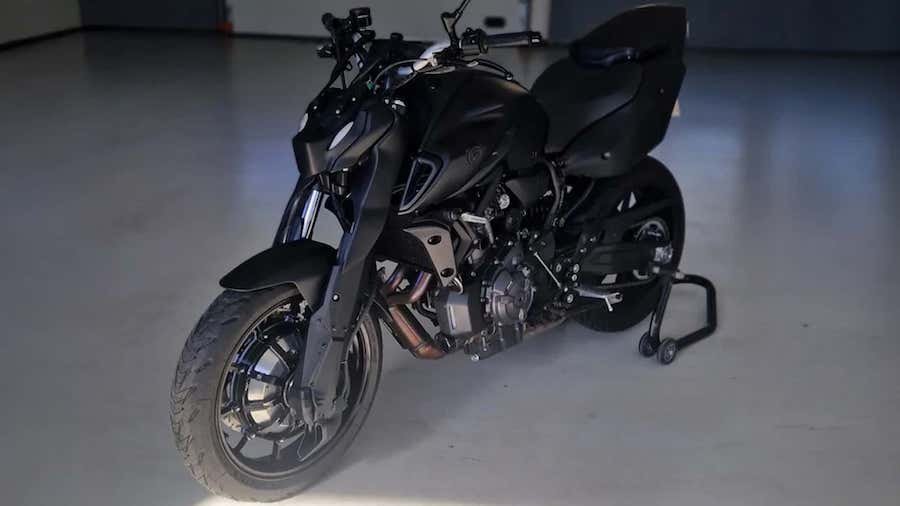
The Yamaha MT-07 is one of my all-time favorite bikes. It’s not the fastest thing on the planet. It’s not the most premium. But that 689cc CP2 twin, that punchy midrange, that playful chassis, the way it’ll loft the front wheel just because you looked at the throttle funny. It’s pure hooligan energy on two wheels.
So when a small French engineering outfit called Furion decided to use the MT-07 as the base for its latest prototype, I paid attention.
Furion isn’t a big manufacturer. It’s an engineering company out of France that specializes in hybrid systems and energy recovery tech. Back in 2017 it teased a rotary-powered hybrid called the M1 that never quite made it to production. This time, it’s back with something arguably more grounded and somehow even more radical.
The M2, as it's called, takes the MT-07 platform and bolts on something that completely changes how we think about hybrids on motorcycles. And that's because the electric motor isn’t at the rear. It’s inside the front wheel.
The M2 uses a hub-mounted motor and generator. Under acceleration, that front unit can deliver a claimed 300 Nm, which is 221 pound-feet, and contribute around 20 horsepower. The rear wheel is still driven by the stock parallel twin, so yes, this is effectively a two-wheel drive motorcycle when you’re on the gas. That’s wild on its own. But the real genius shows up under braking.
Furion calls its system "Eversor," and it claims it can recover up to 27 percent of the energy generated during braking. Normally, motorcycles struggle with effective regen because hard braking unloads the rear wheel. Less weight means less grip, which means less opportunity to harvest energy at the back. Furion flips the equation. Since most braking force loads the front tire, placing the generator in the front hub means regeneration happens exactly where grip increases.
As for packaging, the battery looks like it's housed in the tail end of the bike, which looks funnily out of place given the MT-07's svelte proportions.That said, if you're willing to look past the odd tail section, you could argue that the bike still looks compact and purposeful. Plus, the motor integrated into the front wheel gives the bike a mechanical, almost sci-fi aesthetic.
But perhaps the biggest question is this: What does this translate to on the road? In theory, you get front-end pull under acceleration, which could mean better traction when you’re hammering out of corners. It might also mean fewer unintentional power wheelies since the front wheel isn’t just along for the ride anymore. That raises the big question. Does this kill the MT-07’s hooligan spirit?
Honestly, it depends on tuning. If the front motor engages subtly and only when traction demands it, the core character of that crossplane twin should still shine through. You’d still have that torque-rich shove from the rear, that raw mechanical feel, just with an added layer of electric assist. Think of it less as a leash and more as a smart co-conspirator helping you fire out of turns.
The idea of a hybrid motorcycle usually sounds boring. It usually means engineers are focusing on efficiency rahter than excitemnet. But the M2 clearly wants to break the mold. It’s weird, complicated, and unapologetically experimental.
And the fact that it’s built around one of the most playful middleweight naked bikes ever made makes it even more compelling. If hybrids are going to survive in the motorcycle world, they need to preserve what riders fell in love with in the first place.
Related News


