The Mercedes Test Track In Germany Looks Like A Driver's Dream Come True
It's designed to allow detailed testing of headlight systems under reproducible conditions, though in this case, it's not so much a track as it is a short stretch of highway. According to Mercedes, a "complete country road is authentically recreated over 135 meters."
So Much Room For Activities
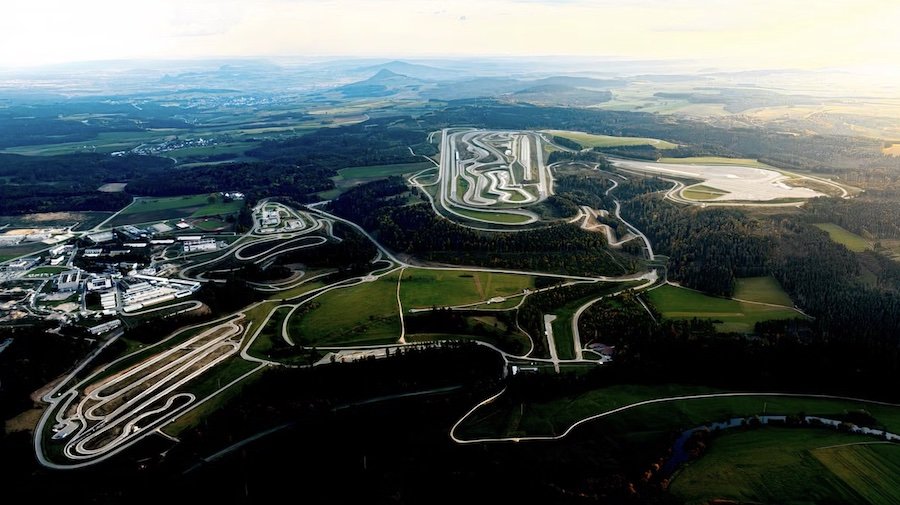
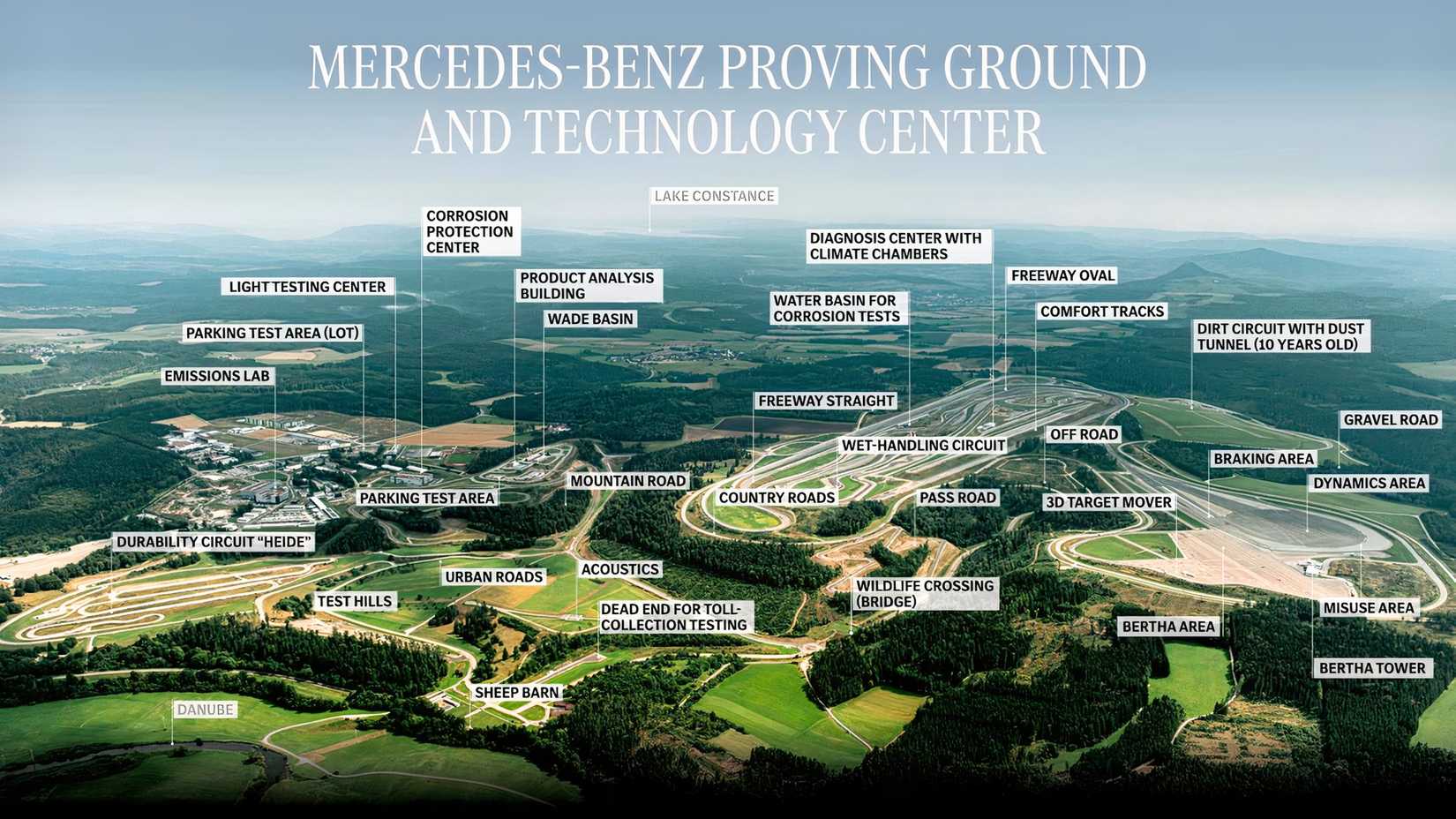
That's an incredible statement considering the distance. If your mind isn't already making the connection, 135 meters are less than one-tenth of a mile. Specifically, it's 442.9 feet, which is an incredibly short distance to pack in a "complete country road." If you look at the picture above showing the entire facility, the light testing center is a tiny section at the top left. It's all enclosed in a building.
Mercedes says that five cars can be tested in parallel, including the simulation of oncoming traffic or vehicles ahead, and the asphalt mixture was specially developed to replicate the reflective properties of an aged road. Reflector posts can be positioned at the sides of the road in 20-meter (65.6 feet) increments and pedestrian dummies can be positioned accordingly.
But That's Just For Lights
Admittedly, we're being a bit sarcastic about Mercedes waxing poetic on its new facility. Truth be told, the Mercedes-Benz proving ground in Immendingen, Germany, is an incredible place. The 1,300-acre plot of land was once used by the German army, but Mercedes has spent well north of $200 million revamping the area to mimic various kinds of driving environments, including long stretches of road and tracks to play on. One of the more recent additions is the automated Heide durability circuit, and it doesn't even need drivers.
"Driving robots" steer the test vehicles completely autonomously along the rough-road track. But that's a good thing, as Mercedes claims "one kilometer on the Heide durability circuit is equivalent to 150 kilometers (93.2 miles) on an extremely poor road, littered with deep potholes, among other things." Each car completes up to 6,000 kilometers (3,728 miles) going around and around the circuit, which would be brutal on a human driver.
Physically testing cars and features is expensive, so, like every other automaker, Mercedes uses a lot of digital testing. Each "module" has a digital twin to get the hardware ready for physical testing. The proving ground is digitally mapped down to the sub-millimeter level, and vehicles and their loads are digitally mirrored, much in the same way as video games like Gran Turismo map tracks and cars. We suspect Mercedes is more precise, though.
"The Immendingen Test and Technology Center is the first digitized Mercedes Benz proving ground – here, real and virtual vehicle testing merge seamlessly. By digitally mapping the proving ground, using automated test programs and employing state-of-the-art sensor technology, we are making vehicle development more efficient, faster and more sustainable than ever before."
- Markus Schäfer, chief technology officer, development & purchasing at Mercedes-Benz
In practical terms, that means Mercedes can create 100 or 200 different variations of a chassis tune to test digitally, then pick out the most suitable to physically test. In total, there are 53.4 miles of physical road with 286 junctions at the Mercedes Global Proving Ground Immendingen, melding 30 test modules together. The driving routes replicate the road conditions and road markings in European countries, but there are also copies of roads and road markings from other countries, including the US.
And now, there's a postage stamp devoted to making those bright headlights a little easier on the eyes.

Related News


