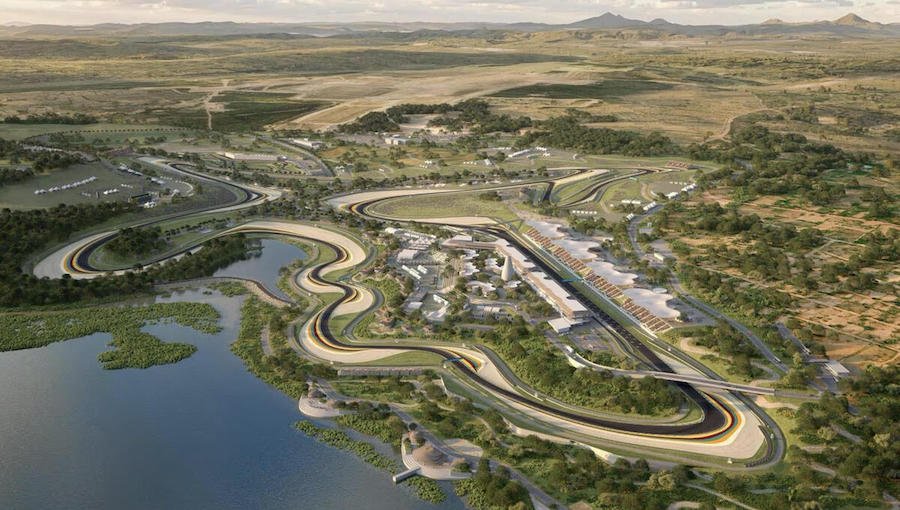
There's no place on the Formula 1 calendar for a grand prix in France or Germany, but there will be in the next few years for one in Rwanda. That sums up the state of play, for not just F1 but the majority of international sport today. Traditional heartlands are no longer sacrosanct, especially when untapped regions of the world offer rich returns.
This isn't necessarily a bad thing. Uninspiring Paul Ricard hasn't been mourned by many F1 teams, drivers or fans (who aren't French) since it dropped off the schedule after 2022, although it's faintly astonishing that Germany hasn't hosted a race since the one-off Eifel GP at the Nürburgring in Covid-affected 2020, especially with Audi having joined Mercedes on the grid. But if F1's eye-watering hosting fees can't be met by either private or public investment, no country should be entitled to a place at the table, especially if demand can be met elsewhere—and there sure is demand for F1 today, given its progress as a global force under Liberty Media since 2017.
In the Rwanda case, a return to Africa for the first time since 1993 would certainly be a good thing and is long overdue, as Lewis Hamilton has consistently pointed out. The new 10-year deal, due to kick in during the early 2030s, once an ambitious new race track is built, is another major landmark for F1 chief Stefano Domenicali and his team, in the wake of the successful US expansion in Miami and Las Vegas. Rwanda is justified by F1's claim of a 100 million-strong following on the African continent, even without a grand prix, and a high percentage of them are under 35. It's great to expose motorsport to fresh eyes, even if it's a shame that fans in countries where racing is rooted must now travel beyond their borders to get their fix.
Naturally, for a country haunted by the atrocities of genocide well within living memory, there's an underlying seam of controversy. Claims of sportswashing followed the announcement last month, for a nation that still has questions to answer on its human rights record. But we've said that before, haven't we? For F1, as in football, boxing and the rest, such queasy inconveniences tend to skim off the surface, along with any suggestions that such massive funding—said to be drawn from a mix of private and public sources—could be spent in ways that might more directly improve the lives of local people.
"Rwanda is one of the world's great success stories," said Domenicali. "A nation of extraordinary natural beauty and stunning landscapes, combined with resilience and courage to overcome and be reborn from challenges of its past. It is a nation filled with ambition, creativity and determination... to become a destination for international investment, innovation and opportunity."
From a sporting perspective, the plans for a circuit based in Bugesera, not far south of the growing capital city of Kigali, are enticing. An initial design for a 3.6-mile, 17-turn layout inspired by established great circuits also includes 200m of elevation change. Ex-F1 driver and two-time Le Mans winner Alex Wurz is involved, which bodes well. Since stepping away from the cockpit, the Austrian has shown the personal qualities that would make for a great FIA president one day.
There's no guarantee the Rwandan GP will happen—not until the circuit exists. But at face value, there's more reason to think it will than it won't. How we feel about that, conflicted or otherwise, is almost beside the point.
Congratulations to Jason Smyth for becoming the first back-to-back Formula Ford Festival winner in the much-loved showcase's 55-year history. But boy, the old junior proving ground is as competitive and contentious as it ever was in its 1970s/1980s/1990s heyday.
Thankfully run in crisp, dry conditions in the wake of Storm Boelo, the grand final at Brands Hatch left a bitter taste for Smyth's rivals Niall Murray and Jordan Dempsey. Let's just say Smyth put up a 'robust' defence while leading from pole position in his Team Dolan Van Diemen. How previous two-time winner Murray came to grief, edged on to the grass by Smyth and into a spin on the run up to Druids, was sadly all too predictable. The winner was lucky to avoid a penalty—but as I well remember from the day Jenson Button left Dan Wheldon spitting Clearways gravel at the close of another contentious final way back in 1998, there are always two sides to every story.
By the time you read this, the Formula Ford swarm will have swept in and out of Silverstone for the Walter Hayes Trophy follow-up, and the British autumn wouldn't be complete without either. Rwanda is welcome to F1, as long as some heartland motorsport traditions are kept alive and continue to thrive.
Related News


