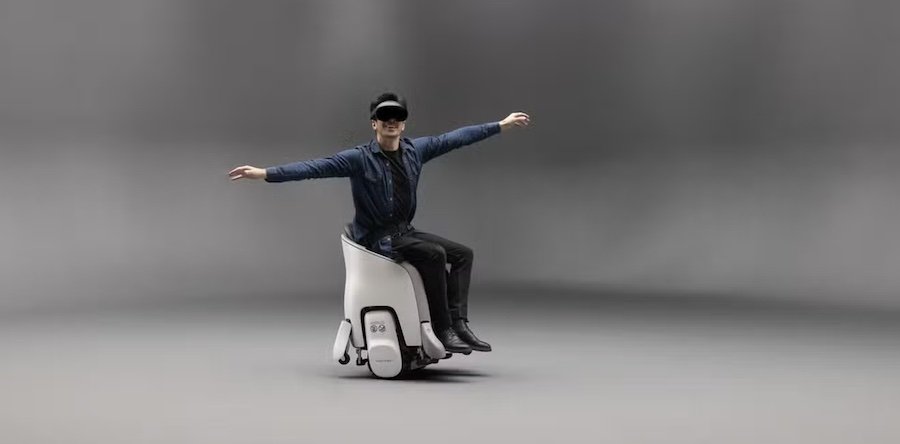
Yes, it's the Uni-One, and it might even launch in the United States at some point.
The wheelchair-esque mobility device is essentially Honda’s answer to the Segway, and while developed primarily as a form of motorized transport for those with physical disabilities, it was actually designed with Honda Robotics’ more widespread idea to “broaden the potential of mobility beyond walking.” Unlike the Segway, which can't be used on public roads in Japan for obvious reasons, Honda is now seeking certification under Japan’s Road Traffic Act in a bid to extend production both domestically and even overseas. It's a move that would undercut the Trump Administration’s auto tariffs in the process.
An evolution of the UNI-CUB concept showcased in 2012, the Uni-One features neither hand controls nor pedals. Instead, (deep breath) human-machine cooperative balance control technology allows the user to steer the Uni-One by angling their bodies into the seat, in much the same way that Segway riders move forward or backwards by leaning their bodies in the desired direction. In the Uni-One, the human-machine software registers slight changes to the user’s posture in the seat, which then powers the two independent electric motors connected to the two rear wheels.
There are also two drive modes for the Uni-One. Low Position Mode allows the user to alight and get seated – in much the same way that it’s easier to fall into an armchair than climb on to a bar stool. The other mode, predictably, is High Position Mode, which raises both the seat and the user’s eyeline, while on the move.
It’s incredibly complicated, but essentially, this system makes the Uni-One completely hands-free, and thus more accessible for people of all ages, of all physical capabilities, and, crucially, less wearing to use. The Segway, for example, can only be operated while standing. Top speed is a not unreasonable 3.7 mph, though the lithium-ion battery still needs some work, as it only offers five miles of electric range.
It is hoped, according to a report in Japan’s Nikkei Asia newspaper and following a recent demonstration at the World Expo 2025 in Osaka, that a small-scale roll-out to Japanese businesses will prove Uni-One’s wide-ranging capabilities. In addition to helping executives move from meeting to meeting more speedily like Toyota's C+ Pod, the Uni-One could also be used by security teams patrolling large complexes and/or cleaning staff maintaining hundreds of square feet of office space.
Widespread domestic launch for private and commercial customers alike is apparently being considered. Further afield, North America, and the US in particular could be potential key markets. Indeed, with the Uni-One far less complex to build than even the smallest of Civics, limited production in the US could be greenlit, undercutting the Trump administration’s auto tariffs in the process. Though again, this would depend on Uni-One’s vehicle certification.
Prices have not yet been confirmed (the Uni-One is currently only available for lease), though Honda is keen to avoid Segway’s mistake. That company slapped a hefty one million yen ($6,800) price tag on its two-wheeled scooter when the company first arrived in Japan, leading to poor sales.
Nouvelles connexes


